

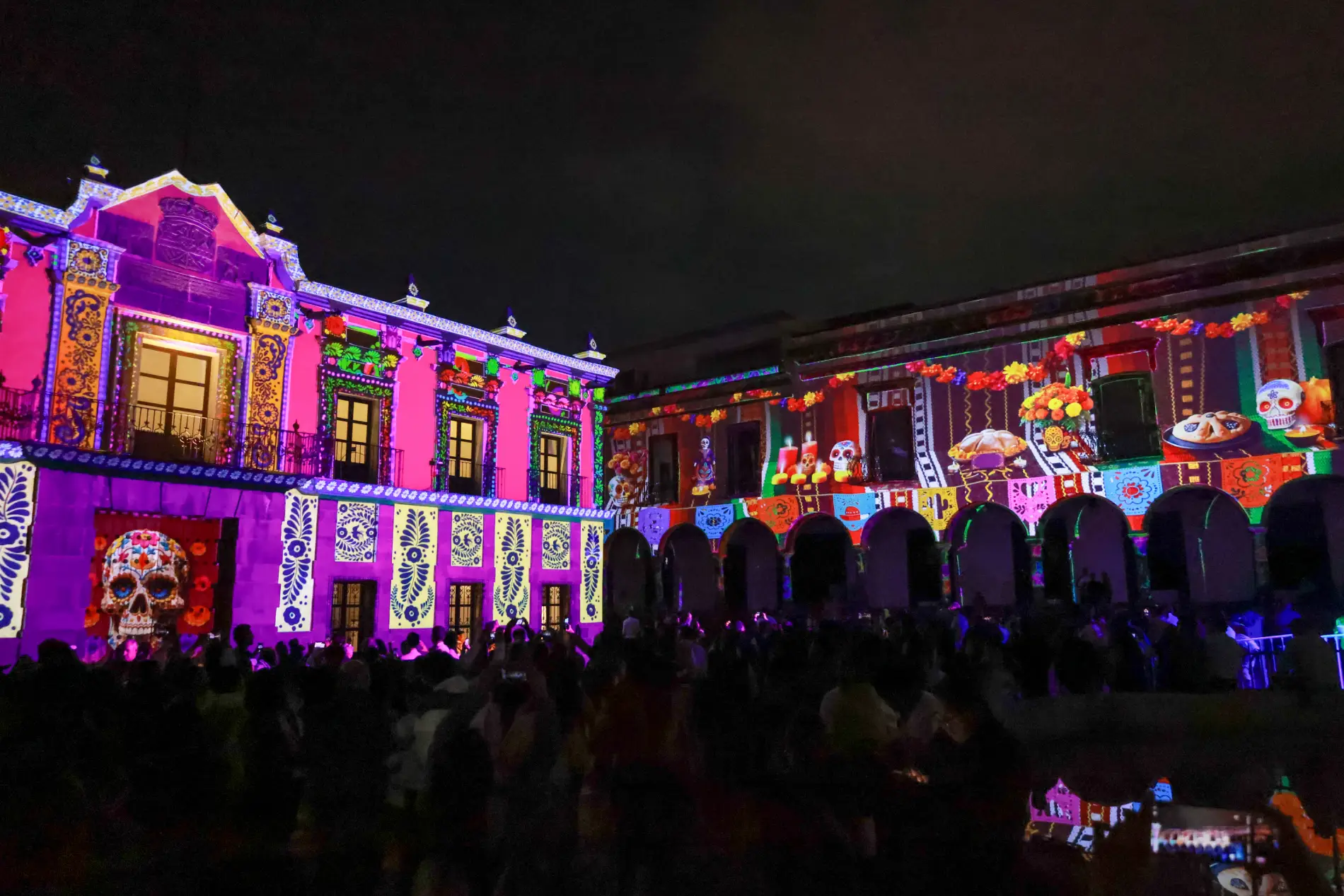
Lights of Puebla
Memory revealed by light
Cities hold secrets. They do not hide them entirely; they simply wait for someone to learn how to see them.
Some cities are understood through their streets. Others reveal themselves in the stories held within their squares and buildings. Puebla, however, is a city that unveils itself slowly—through memory—as if every wall and every dome carried the imprint of time.
When night falls, the city changes. Stone façades gain new depth, towers stand in sharper contrast against the sky, and silence seems to return a voice to the architecture. That is when light appears.
Not as a mere glow, but as a language capable of revealing what has always been there: the history etched in stone, the beauty of detail, the memory that inhabits space.
Lights of Puebla is born from this idea.
Founded in the 16th century and recognized as a UNESCO World Heritage Site for over four decades, Puebla is a city where history remains alive—in its architecture, its neighborhoods, and the life that flows through its streets. Each building forms part of an urban landscape that has witnessed centuries of culture, knowledge, and artistic creation.
The Glow México festival invites us to rediscover that memory through light.
Bringing to our city the experience of over twenty years from the renowned international GLOW festival held in Eindhoven, Netherlands, this is the first time it extends beyond its country of origin. It gathers artists who use light as a medium to engage in dialogue with the city, offering a new dimension to the visual arts—not to transform its identity, but to reveal new ways of seeing what has existed for nearly five centuries.
During the festival, the Historic Center and its vast heritage become a space where art, technology, and legacy converge. Architecture is no longer just a backdrop; it becomes a living narrator, restoring memory. Details emerge, spaces transform, and the city is seen through a different lens.
At the same time, Lights of Puebla is a collective experience. It does not exist solely in buildings, but also in the people who walk the streets, who pause, who look up and discover something they had never seen before.
Thousands of people traverse the same streets, rediscover the city from new perspectives, and share a common moment in public space.
Because when light appears, something changes.
The city becomes a stage. Architecture begins to speak.
Memory is restored. And for a moment, Puebla reveals itself once again—through light.
Made possible by